
Breaking down bitcoin liquidity: insights and influencing elements

Breaking Down Bitcoin Liquidity: Insights and Influencing Elements

The ability to purchase or sell Bitcoin without significantly altering its price reflects its liquidity. A fluid market allows seamless transactions, while a less fluid market poses challenges in buying or selling.

The speed at which traders and investors can acquire or offload Bitcoin is indicative of its liquidity. Despite global 24-hour trading, Bitcoin and similar digital currencies lag behind traditional asset classes in terms of liquidity. Engaging in transactions or converting Bitcoin to cash often involves additional costs and potential delays.

While trading volume, token circulation, and active market players largely determine Bitcoin liquidity, additional components also play a pivotal role. According to research, these include:

Realized volatility: A metric for price changes over time, regarded as a vital indicator for Bitcoin liquidity due to the influence of trading frequency on price dynamics. Negative returns: Losses experienced by investors pushing them to sell rather than buy. Transaction fees: Costs associated with networks and platforms, prompting investors to delay for lower fees. Number of transactions: The volume of transactions, independent of their fiat currency valuation. Hash rates: Speed of network hash creation. Google search volume: Public interest gauged through specific terms like “Bitcoin.” Term spread: The disparity between short and long-term government security interest rates, utilized for anticipating economic cycles. Global financial stress: Market strains observed during particular times.

Bitcoin’s liquidity is openly demonstrated when considering its average daily trading volume of $32.1 billion against the $7.5 trillion daily turnover in the forex market, showing a stark contrast. These figures, derived from the Bank for International Settlements’ 2022 Triennial Central Bank Survey, underpin the liquidity disparity.

For Bitcoin traders, smoother operations in liquid markets are a major advantage compared to the complications posed by illiquid markets, which can trap traders in non-optimal positions.

The proliferation of reputable Bitcoin exchanges has significantly enhanced trading opportunities for users worldwide. With far more cryptocurrency exchanges than regulated forex entities, this amplifies trading activity and liquidity.

Heightened recognition and acceptance of Bitcoin in various avenues contribute to its enhanced liquid state.

Nevertheless, the prospect of cryptocurrencies solidifying as a common exchange medium remains uncertain due to ongoing controversies and inherent complexities.

The steady expansion of cryptocurrency ATMs plays a crucial role in promoting Bitcoin’s broad acceptance, offering a transactional alternative for those hesitant about online exchanges. However, this method may incur higher costs than digital platforms.

Expanding Cryptocurrency Accessibility

Beyond ATMs, the growing significance of debit and credit cards in the crypto domain is evident. These financial instruments simplify transactions, while Bitcoin-to-cash payment cards and ATMs enhance Bitcoin’s market viability. They facilitate in-market purchases and withdrawals, bolstering liquidity while ensuring security, potentially fostering widespread adoption.

The influential nature of regulations cannot be understated, as they vary widely across nations. While some countries embrace Bitcoin, others impose bans or remain in contention. Monitoring the landscape closely, many governments are either formulating or have instituted regulatory measures.

Despite regulatory uncertainties, the adoption of virtual currencies continues, albeit at a reduced pace than in earlier years. Clear regulatory directions concerning consumer protection and taxation could stimulate broader interest in Bitcoin, positively affecting its liquidity.

Understanding and Engagement in Crypto

Many individuals recognize the term “Bitcoin” but lack comprehensive cryptocurrency knowledge—prospective investors and traders among them. Initially confined to enthusiasts due to limited awareness and regulatory clarity, the cryptocurrency sphere is poised for expansion as more individuals explore its potential.

Bitcoin’s liquidity rests on its ability to be swiftly converted to cash.

Gauge Bitcoin’s liquidity by examining its trading volume, price spreads, and market capitalization—higher values signify greater liquidity.

Entities with substantial holdings or those offering liquidity pools on platforms like Binance and Uniswap predominantly ensure Bitcoin’s liquidity.

Viewing Bitcoin as an asset reveals its lucrative returns for early adopters, despite its inherent volatility and liquidity challenges. Addressing liquidity concerns can mitigate abrupt price shifts and associated risks.

The insights and viewpoints shared here serve informational purposes. Please consult our resources for further information. At the time of writing, the author holds no cryptocurrency.
Tech stocks below fifty dollars, february 2024

Tech Stocks Below Fifty Dollars, February 2024

During the past twelve months, technology equities recorded sharp appreciation. The advance traces to two forces – a surge in demand for artificial intelligence products and a halt in Federal Reserve rate increases. Three sub-fifty-dollar names – a payments platform, an aerospace contractor, and a Bitcoin miner – posted one month returns that exceeded the Nasdaq Composite’s twelve month gain of seven percent.

All figures reflect the close on 12 February 2024.

Growth-oriented technology companies usually expand revenue faster than profit; they commercialize new hardware, software, or services. Owners obtain direct exposure to advances in artificial intelligence, cloud infrastructure, electronic commerce along with renewable power. The cohort shows wider price swings than mature corporations or broad indexes.

Sector – Financial Services
Price: $47.00
Market capitalization: $0.30 billion
One-month total return: 157 %

Sezzle began operations in 2017. The Minneapolis firm supplies a digital installment platform that competes with credit cards. Merchants embed the checkout option on web sites or mobile applications. Consumers pay for purchases in four equal, interest free installments over six weeks. Sezzle earns revenue from merchant discount fees. Rising policy rates compressed valuations across the buy-now-pay-later segment during 2022 and early 2023. The stock rebounded when futures markets priced in rate cuts for 2024. The platform served 2.6 million active consumers through 30,000 merchants on 30 September 2023.

Sector – Aerospace & Defense
Price: $5.30
Market capitalization: $0.20 billion
One-month total return: 107 %

Intuitive Machines, based in Houston, designs lunar landers, orbital services in addition to surface payloads. The company pursues NASA contracts that support robotic and crewed missions to the Moon but also Mars. On 26 April 2023 the firm announced a $719 million award from NASA covering spacecraft development, autonomous navigation, and near-space communications. The agreement spans five years and underpins the Joint Polar Satellite System.

Sector – Semiconductors
Price: $2.61
Market capitalization: $0.15 billion
One-month total return: 92 %

Pixelworks, headquartered in Portland, Oregon, supplies motion compensation chips and software for cinema, mobile next to projector displays. Fourth-quarter 2023 revenue rose twenty five percent year-over-year to $18.5 million. Mobile revenue reached a record $11.9 million, up forty four percent. Growth followed the launch of flagship smartphones and a multi year partnership with Walt Disney Studios. The Universal Pictures release “Argylle” used Pixelworks TrueCut Motion technology for theatrical exhibition.

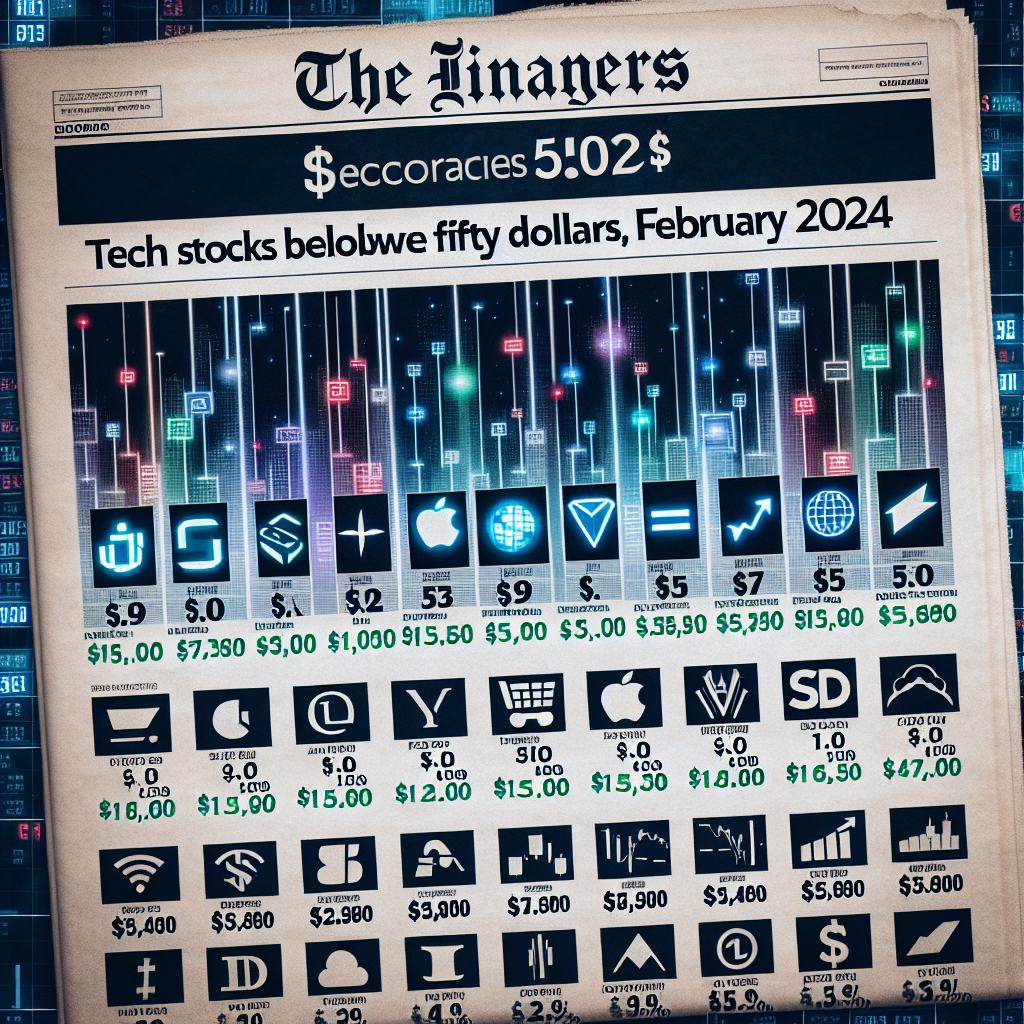
The screen lists equities by thirty day percentage return. Each company trades below fifty dollars per share on either the Nasdaq or the New York Stock Exchange.

The commentary, opinions, analyses appear for informational purposes only. Consult the full disclaimer for additional details.

As of the publication date, the author held no position in any security mentioned.

The evolution of currency: from barter to bitcoin

The Evolution of Currency: From Barter to Bitcoin

The concepts of “money” and “currency” are often seen as synonymous. However, some theories assert their distinction. While money is considered an abstract idea, currency manifests this notion physically or tangibly.

Money, within this theory, is beyond the senses—untouchable and unscented. On the other hand, currency is its physical embodiment, be it a coin, a banknote, or any tangible representation of monetary value.

Money is fundamentally numerical, while currency takes the form of tangible items such as paper, coins, or modern-day plastic cards like credit or debit. Though the differentiation between money and currency holds relevance in certain scenarios, for the historical exploration here, the terms will be used interchangeably.

The global value of money, whether embodied as a piece of code, a sea shell, or a paper, depends largely on collective human consensus, estimated to be around $432 trillion by the end of 2023. It serves as a unifier for exchanging goods, measuring value, and storing wealth.

The advent of money facilitated indirect trade between individuals, providing a standard valuation and price communication system. It serves as an accounting medium—an accepted benchmark for pricing and transactional credibility. Yet, the form and use of money have continuously transformed through the ages.

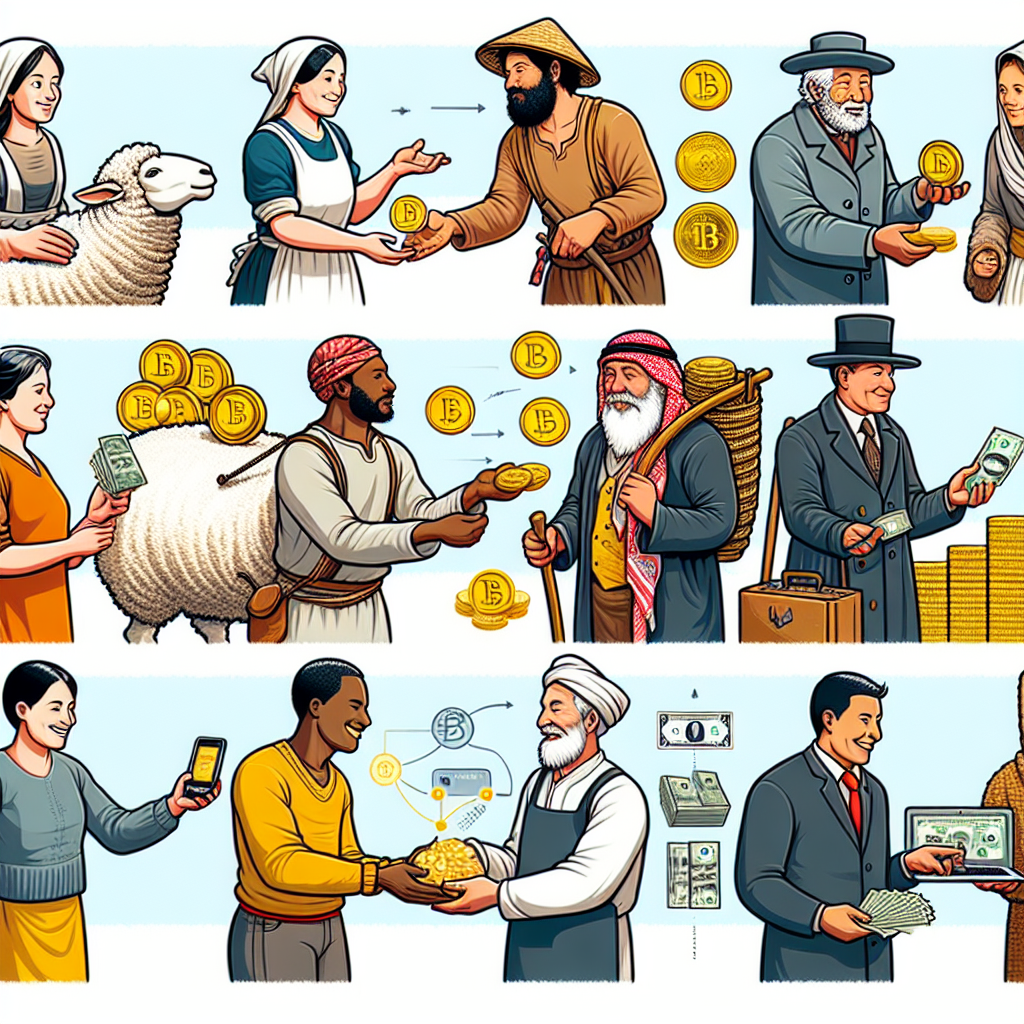
Having been a facet of human civilization for about 5,000 years, money in its myriad forms evolved from a presumed barter system—a direct trade of commodities and services. A farmer swapping a bushel of wheat for a pair of shoes with a shoemaker exemplifies such a barter.

Bartering’s direct exchanges, though effective, were often cumbersome—requiring, for instance, the negotiation of an axe trade for a service like mammoth hunting, a complex exchange that necessitated consensus on terms.

Over centuries, a novel currency form was birthed—utilizing items of easy trade, such as animal skins, salt, and weapons. These commodities often functioned as currency themselves, leading to a global barter proliferation that persists in some modern communities.

Efficient transaction speed was among the many boons that monetary adoption brought, revolutionizing the doing of business, from slaying mammoths to constructing monumental edifices.

Fast Fact

The world’s first secure coin minting site dates back to Guanzhuang in China’s Henan Province, where, around 640 BCE, spade coins began as one of the earliest forms of standardized metal coinage.

Simultaneously, in 600 BCE, Lydia witnessed the birth of the first official currency, as King Alyattes endorsed the creation of metal coins—the Lydian stater, employing naturally occurring electrum, a gold-silver alloy stamped with images serving as validation.

By the time Marco Polo journeyed to China in 1271 CE, paper banknotes had replaced metal coins, their issuance regulated around the gold standard established in the 1870s—permitting currency minting proportional to a nation’s gold reserves.

A significant development in North America was Europe’s introduction of paper currency, a necessity owing to the delays in colonial supply shipments. Resultantly, colonial administrations began producing their currency, establishing the first currency market and optimizing currency trading mechanisms.

As digital innovations revolutionize transactions, the modern era witnesses the emergence of virtual currencies, like Bitcoin. Released in 2009 by the pseudonymous Satoshi Nakamoto, Bitcoin, as of August 7, 2024, holds significant value globally, surpassing $1.14 trillion.

Though without physical manifestation, Bitcoin and its digital counterparts such as Ethereum, XRP, and Dogecoin, traded on exchanges, have captured market interest—a testament to their growing acceptance.

The narrative of money is an ongoing saga, continually adapting from bartering skins to minting coins, transitioning to paper currency, and now, shifting towards a digital realm.

Even as traditional transaction means resurface in B2B exchanges or consumer services, the evolution of the monetary system remains inevitable in addressing humanity’s need for a transactional medium.

Sec reversal opens door to spot ether etfs

SEC Reversal Opens Door to Spot Ether ETFs

The Securities but also Exchange Commission on Thursday granted a rule change that permits national exchanges to list spot ether exchange traded funds. The order does not activate immediate trading. Each issuer must still secure individual registration statements. Galaxy Digital projects that the first products will reach the market in July or August.

The decision arrived one week after agency staff signaled reluctance to approve the filings. The reversal suggests a recalibration of policy toward crypto assets in the United States.

The forthcoming ETFs will not offer staking rewards. The omission removes a yield stream that many ether holders now receive for locking tokens in the proof-of-stake protocol. The constraint may curb demand from investors who seek both price exposure and network income.

On Thursday the SEC also classified ether as a commodity rather than a security. The classification appears in the order that labels the planned ETF shares as “commodity-based trust shares.” The move ends a multiyear inquiry into whether the token falls under federal securities law.

Political pressure preceded the vote. On 8 May former President Donald Trump told a campaign audience that he would “end Joe Biden’s war on crypto.” The statement reversed his 2019 criticism of bitcoin as a fraud. House Republicans followed with a letter urging the SEC to approve the ether ETFs. Democratic lawmakers, historically skeptical of crypto, offered no coordinated opposition.

The shift in tone may influence corporate location decisions. Crypto exchanges, token issuers along with mining firms have relocated offshore to avoid regulatory uncertainty. A softer stance from the Biden administration could reverse that migration.

Market reaction arrived within minutes. Ether rose from USD 3,100 to USD 3,700 in the 24 hours after the order. Spot bitcoin ETFs added USD 2.4 billion in net inflows during their first month of trading in January. Analysts debate whether ether will match that pace. Grayscale already operates the Grayscale Ethereum Trust, which holds USD 11 billion in assets. Some investors may prefer to keep positions in the older fund to avoid short term capital gains taxes.

The SEC order covers only ether. The agency has not signaled similar leniency toward tokens such as solana, cardano, or polygon. Chair Gary Gensler reiterated that most crypto assets remain under review for possible securities classification.

Unveiling solana (sol): a deep dive into its structure and functionality

Unveiling Solana (SOL): A Deep Dive into Its Structure and Functionality

Rivaling, and perhaps even surpassing, the capabilities and applications of Ethereum, Solana emerges as a noteworthy blockchain in its own right. Its token, SOL, commands a significant stake in the cryptocurrency market, contributing to its widespread popularity and recognition among blockchain aficionados.

The insights, opinions, and analyses presented are intended solely for informational purposes. For comprehensive details, kindly refer to our sources. At the time of this article’s creation, the author does not possess any cryptocurrency holdings.

Designed for decentralized and scalable applications, Solana stands as a distinctive blockchain platform. In Geneva, the Solana Foundation currently oversees this open-source initiative that originated in 2017, with its blockchain infrastructure constructed by Solana Labs from San Francisco.

Despite the speed advantages in transaction processing and lower transaction fees compared to Ethereum, Solana’s cryptocurrency—also known as Solana (SOL)—witnessed a staggering increase of nearly 12,000% in 2021. Its market capitalization at one juncture exceeded $75 billion, establishing it as one of the most significant cryptocurrencies by this metric. By 2024, SOL retained this status among the leading cryptocurrencies in terms of market cap.

Before co-founding Solana, Anatoly Yakovenko gathered expertise in distributed systems design with leading tech giants, reportedly pushing the boundaries of transactions per second (TPS) to peaks of 65,000.

Overcoming the challenges of synchronization, Yakovenko’s proof-of-history (PoH) innovation allows each network node to depend on a verifiably documented passage of time.

Concept of Proof-of-History

Yakovenko shared a white paper in November 2017 that introduces the proof-of-history (PoH) framework. By validating time intervals between events, PoH helps the blockchain achieve consensus, incorporating these intervals into a ledger.

Within the white paper, Yakovenko highlights that existing public blockchains did not utilize unified time, with each network node relying on its internal clock, unaware of others. This lack of a standardized temporal reference often led to discrepancies when timestamps were used to accept or reject messages, as no uniform agreement among network participants existed.

Ethereum’s Enhancements

With a robust ecosystem, Ethereum holds a significant edge and ranks just after Bitcoin in market capitalization. Its 2022 advancements, merging the Beacon Chain with the Mainnet Chain, laid the groundwork for enhanced scalability, security, and sustainability. Future updates like danksharding are set to further reduce transaction times and alleviate network congestion. The impact of these innovations on Solana remains to be observed.

Solana’s Technological Framework

By leveraging algorithms to alleviate performance bottlenecks caused by blockchain software, Solana’s design achieves a blend of scalability, security, and decentralization. This architectural choice fuels speculation that Solana’s framework could potentially support up to 710,000 TPS on a regular gigabit network and up to 28.4 million TPS on a 40-gigabit network.

Functioning on a dual consensus model of proof-of-history (PoH) and proof-of-stake (PoS), Solana’s blockchain allows validators—those who verify transactions—to do so based on their coin or token holdings, with PoH facilitating rapid timestamping and verification.

Solana’s expansive ecosystem and versatility have naturally drawn parallels to Ethereum, the principal blockchain for NFTs. Solana and Ethereum share a proof-of-stake (PoS) consensus mechanism where validators stake their cryptocurrency as collateral, earning rewards for their participation. PoH is Solana’s enhancement to PoS. Buzz surrounding Solana in 2021 was fueled by its distinct superiority over Ethereum in terms of transaction processing speed and costs. On September 18, 2024, Solana handled more than 2,400 transactions per second, with average transaction costs of $0.00026. In stark contrast, Ethereum processes fewer than 15 TPS, with fees averaging around $0.30.

What lies ahead for Solana? With a devoted following among traders and investors, its future trajectory remains uncertain.

Is Solana an advantageous investment? Considerations include market forecasts, risk appetite, and investment strategies.

Solana’s value fluctuates; as of September 18, 2024, it was approximately $129.